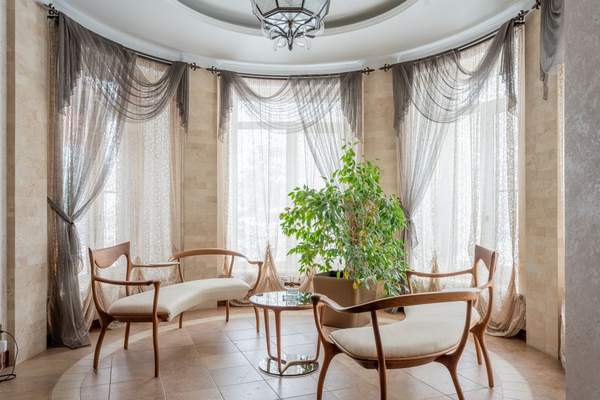
A curved sofa changes the mood of a living room. Its rounded back and softened edges create a more relaxed silhouette than a conventional boxy sofa. Curves can make a room feel more conversational, less rigid and warmer, provided the sofa is chosen at the right scale and positioned with care.
The best rooms use a curved sofa as a living room centrepiece and let its shape influence the rug, coffee table, lighting and circulation. This helps the statement piece feel integrated rather than staged.
Why the Curved Sofa Trend Feels Current
Curved seating is not new; rounded sofas have appeared in influential interiors for decades. What feels current is the way the shape has been adapted for everyday homes. Shoppers can now find compact two-seaters, modular sections, chaise designs and gently bowed three-seaters suitable for British living rooms.
The trend also reflects a move away from hard, highly minimal spaces. Rounded furniture introduces softness without extra decoration. One curved sofa can balance rectangular windows, cabinets and architectural lines and make an open-plan area more welcoming. Restraint matters, though. One strong curved piece usually looks more considered than a room filled with arches, circles and wavy accessories.
Choose the Curve That Suits Your Room
A shallow bow is easier to place and often works well in a rectangular lounge. A dramatic crescent needs more floor space because both its front and back become part of the design. Modular curved seating suits larger rooms, but it requires accurate measuring so the depth and walking routes work in daily life.
Measure the full footprint
Mark the sofa’s width, depth and curve on the floor with masking tape. Include the widest point of the arms and leave a clear route to doors, fireplaces and adjoining rooms. Curved designs can look compact in photographs while occupying more central floor area than a straight sofa with similar capacity. Check delivery access too, particularly in flats and terraced houses.
Test the usable seating
A sweeping back may look generous, but the seat can narrow at the ends. Sit on the model where possible and check depth, back support and cushion firmness. Good curved sofa styling begins with a piece that remains comfortable in everyday use, not merely impressive.
Build the Layout Around Conversation
A curved sofa naturally directs attention inward, making it useful for sociable layouts. Instead of pushing it tightly against a wall, bring it slightly forward so the outline can be appreciated. In a larger room, place two occasional chairs opposite or at an angle. In a smaller room, one lightweight chair may be enough.
Consider a 4-by-4-metre lounge with a bay window. A gently curved three-seater can face the fireplace while sitting slightly away from the back wall. An oval coffee table follows its line, and a slim armchair near the bay completes the seating area without blocking the window. The arrangement feels open, yet the route from the door remains clear.
Natural internal linking opportunities include arranging furniture in a small living room, choosing the right sofa size, and mixing cushions and throws.
Balance Curves with Straighter Elements
Keep a curved sofa looking fresh by contrasting it with a few linear details. A straight media unit, rectangular artwork or slim floor lamp gives the eye a visual pause. Without that contrast, too many rounded pieces can make the room feel themed.
An oval or irregular coffee table echoes the sofa without copying it exactly. A rectangular table with softened corners provides stronger contrast. A large rectangular rug adds structure, while a round rug can emphasise the sculptural effect in a spacious room. Whichever shape you choose, make it large enough to connect the main seating pieces rather than floating beneath the coffee table.
Select Colour and Fabric for Real Life
Bouclé helped popularise the curved look, but it is not the only choice. Textured weaves, velvet, chenille and smooth performance fabrics all suit a rounded frame. Pale neutrals highlight the silhouette, while olive, rust, deep blue and warm brown give the sofa more presence and may be easier to live with in a busy household.
Match the fabric to how the room is used. Homes with children or pets may benefit from tightly woven, cleanable upholstery rather than a looped texture that can snag. Strong sunlight can fade some colours, so order a sample and view it beside the window at different times of day.
Keep cushions selective. Two or three in varied sizes and tactile fabrics are often enough. Filling the entire back can hide the curve you paid for.
Use Lighting and Space to Show the Shape
A floor lamp behind one end of the sofa can trace its outline in the evening, while a pendant centred over the seating zone makes the arrangement feel intentional. Mix overhead, floor and table lighting rather than placing every light at the same height.
Leave some negative space around the sofa where possible. A curved back seen against a plain wall, curtain or open floor has more impact than the same piece crowded by small tables and accessories.
Mistakes That Make a Curved Sofa Hard to Live With
The biggest mistake is buying for appearance without checking comfort, delivery access and circulation. Another is choosing a sofa that is too large, then squeezing it against a wall where the curve looks awkward. A gentler arc is often the better statement sofa idea for a compact home.
Avoid repeating curves in every object. Do not assume the television, fireplace and sofa must sit on one rigid axis either. A slight angle can create a more natural arrangement, especially around a bay, alcove or open-plan connection. Test positions with floor tape before committing.
Frequently Asked Questions
Are curved sofas suitable for small living rooms?
Yes, but choose a compact design with a shallow curve and raised legs. Measure the full footprint and protect clear walking routes. A dramatic crescent generally suits a larger room.
Will a curved sofa go out of style quickly?
Curved seating has long-standing design roots, so the shape itself is not new. A well-proportioned model in a versatile fabric should age better than an exaggerated version chosen solely for its trend value.
What coffee table works with a curved sofa?
Oval, round and irregular tables complement the flow, while rectangular tables with rounded corners add useful contrast. Leave enough space between the seat and table for comfortable movement.
Should a curved sofa sit against a wall?
It can, especially when the curve is subtle, but pulling it slightly forward usually shows the silhouette more effectively. In open-plan rooms, the curved back can also help define the seating zone.
A Statement Piece That Still Has to Work
The curved sofa living room trend succeeds when shape and practicality support each other. Choose a curve that fits the room, preserve circulation, balance rounded lines with straighter details and select upholstery for daily use. Styled with restraint, a curved sofa can feel soft and contemporary without turning the room into a trend display. It becomes memorable, comfortable and completely at home in the space.